The Australian Wildlife Traceability System (AWTS) is delivered by a project led by the Department of Climate Change, Energy, the Environment and Water (DCCEEW) is a world-first, combining robust, marine-grade and live animal safe hardware with a secure digital platform to support provenance recording of Australian coral and Australia's CITES obligations. Following completion of the pilot trial in August 2026, the project has moved into its final phase, Implement and Go-Live.
The system referred to in earlier updates as the Coral Traceability Solution (CTS) is now formally the Australian Wildlife Traceability System (AWTS). The system, the team and the scope for go-live are unchanged.
Wrapping Up: Pilot & Validate
The Pilot and Validate phase ran from June to August 2026. Eight industry participants used the AWTS mobile and web applications in their own facilities, in parallel with their existing processes, with government stakehodlers engaged throughout.
Across the pilot:
- 8 industry participants took part
- 160 specimens were tagged
- 131 items of feedback were raised
- 39 improvements have been delivered or are underway
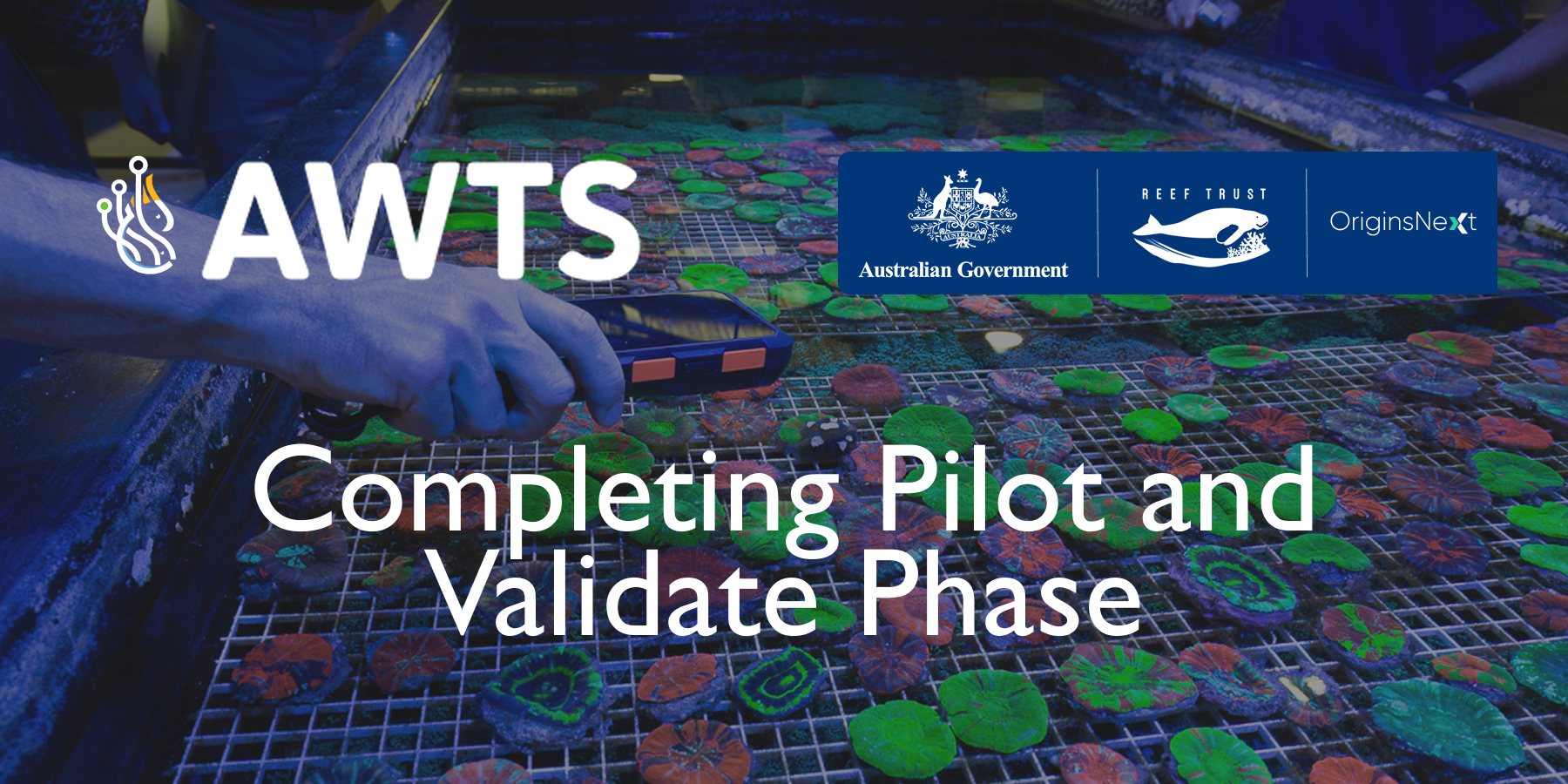
As part of the pilot, each industry participant was visited on site or trained virtually on tagging and using the hardware devices, with site visits across Cairns, Townsville, Mackay, Hervey Bay and the Sunshine Coast.
What Industry Told Us, and What We Changed
Several key enhancements and all defect fixes have been implement based on feedback throughout the pilot. These include:
- Clearer in-app guidance where the workflow was ambiguous
- Domestic purchase set as the default for participants without a harvest licence
- Harvest locations filtered to the participant's own state
- Real-time search on every list
- Improved performance when scanning more than 100 items
- Removal of the export template from domestic orders
- Scientific names displayed in italics, meeting naming convention
- A range of smaller usability fixes throughout the app
- Improved performance of camera in blue light conditions
Hardware and tagging were tested in live facility conditions across the pilot, including the LF RFID tags, the scanning devices and the wands. Feedback was positive, and the applications' support for QR codes and manually entered identifiers was confirmed in use.
A further set of suggestions is under consideration for future releases, including supporting multiple ID types (e.g. RFID and QR Code) on a single specimen, an optional harvest location for domestic purchases, downloadable packing lists, and the ability to pause and return to data entry.
Engagement through the pilot extended beyond industry participants with commonwealth, state and territory and international regulatory agencies was also consulted.
Next Steps
With the pilot complete and the resulting changes largely delivered, the focus now shifts to readiness for go-live. During this phase the team will:
- Complete readiness activities across the system
- Prepare and deliver onboarding and training for industry and regulators
- Finalise the regulatory elements required prior to go-live
AWTS is due for implementation in late 2026. Industry participants will be contacted directly regarding onboarding, training and hardware ahead of go-live.
For more information on the Australian Wildlife Traceability System, visit OriginsNext.


.svg)
.svg)